
Breakthrough Dyslexia Research
The Dyslexia-CV Discovery (1973)
An inner-ear (Cerebellar-Vestibular [CV]) dysfunction was found by Drs. Frank and Levinson to characterize over 96% of a large dyslexic sample. By contrast, there was a complete absence of cerebral cortical signs. These data clearly suggested that Dyslexia was of a CV rather than of a cortical origin as believed for over the past 100 years (Dysmetric Dyslexia and Dyspraxia: Hypothesis and Study, Frank, J & Levinson, H.N., Journal of American Academy of Child Psychiatry, 1973).
“Blind” Neurological Validation
In order to validate the above CV findings, a subsample of dyslexics was sent to two outstanding pediatric neurologists — Drs. Carter and Gold — at Columbia-Presbyterian Hospital, Neurological Institute. On "blind" examinations, these clinicians also found that 96% of the dyslexics had CV signs and none cerebral signs.
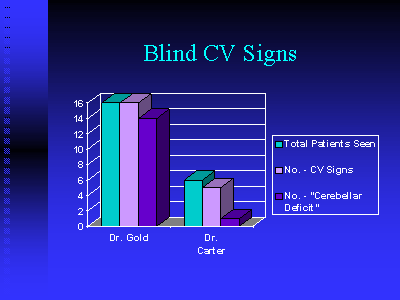
Slide One: Blind CV Signs
The total number of dyslexic patients sent to Drs. Carter and Gold for "blind" neurologic examinations, and the number of patients found to have CV signs and stated to have a "cerebellar" deficit. From A Solution to the Riddle — Dyslexia, p. 82.
“Blind” Electronystagmography (ENG) Exam
A subsample of dyslexics were also sent "blindly" to outstanding inner-ear experts (neurotologists) in leading New York City hospital centers for specialized inner-ear testing. As noted in Figs. 1 and 2c, A Scientific Watergate — Dyslexia, over 90% of referred dyslexics were found to have positive evidence of an inner-ear dysfunction on ENG — a test initially designed by Nobel Laureate, Sir Robert Barany.
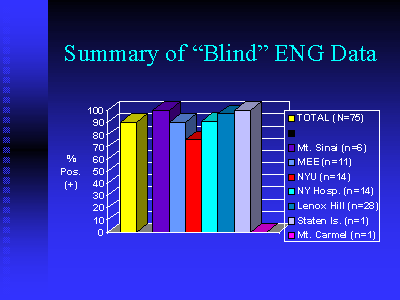
Slide Two: Summary of "Blind" ENG Data
Frequency distribution of spontaneous and positive nystagmus and other ENG pathologic parameters (i.e., vestibular hyper- and hypo-reactivity [RVR] and asymmetric vestibular ocular responses to caloric stimulation [DP] as a function hospital centers. From A Solution to the Riddle — Dyslexia, p. 82.
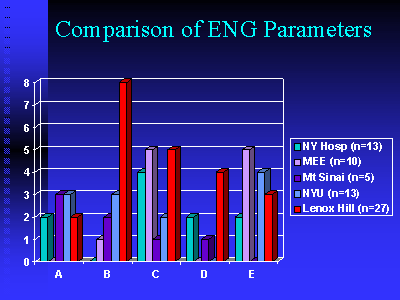
Slide Three: Comparison of ENG Parameters
Positive frequency distribution of "blind" ENG's as a function of medical centers where the testing was done, and total percent positive.(Mt. Carmel Hospital, Staten Island Hospital, Mt. Sinai Hospital, M.E.E.=Manhattan Eye and Ear Hospital; N.Y.U.=New York University Medical Center; N.Y. Hospital=New York Hospital/Cornell Medical Center.) Taken from A Solution to the Riddle — Dyslexia, p. 82.
A CV-based Dyslexia Theory
All these data together with a variety of other findings definitely proved for the very first time that Dyslexia was characterized by a CV dysfunction. Because CV dysfunction results in Dysmetria and Dyspraxia, Dyslexia was redefined and called Dysmetric Dyslexia and Dyspraxia — leaving open the possibility that there were other minority causes of the dyslexic syndrome.
The Orton Society Sanction
These 1973 data were presented at an Orton Society meeting (1975) so that they might be reviewed by the physicians contributing to the original data. Clearly, the CV findings and origins of Dyslexia refuted Samuel Orton's belief that Dyslexia was due to a dominance impairment between the cerebral cortical right and left hemispheres or "brains." (For those who may not know, The Orton Society is one of the oldest nonprofit organizations initially created to help dyslexics. From the data presented, it appears that the aim of those in charge changed — becoming political and self-serving rather than altruistic.)
A Stacked Deck
Drs. Carter and Gold refused to attend the above scientific meeting — publicly and privately refuting their very own stated and written cerebellar findings. Instead, Dr. Martha Denckla attended for them — claiming that when Dr. Gold stated there was a cerebellar deficit — he didn't mean it when he wrote "mild" or "moderate" "cerebellar deficit." In other words, by analogy, she claimed that women are pregnant only at term — not in the first or second trimesters.
Since all leading neurotologists performing the ENG testing were highly enthusiastic about this data and the inner-ear or CV origin of Dyslexia, none were invited by The Orton Society to attend and discuss their own findings. Instead, a neurologist was invited by the "Ortonians" to refute the reliability of the ENG technique — stating, in fact, that the ENG "abnormalities" were "normal."
Orton Society Slander
Following the meeting, leading members of The Orton Society slandered this research and its researchers in order to preserve an outdated theory — the basis of which Orton himself eventually refuted. (Refer to A Solution to the Riddle — Dyslexia, Levinson, Springer-Verlag, 1980 and A Scientific Watergate — Dyslexia, Levinson, Stonebridge, 1994).
The Columbia-Presbyterian Hospital Neurological Institute Cover-Up
As previously noted, only CV signs were found characterizing the dyslexic neurological reports of Drs. Gold and Carter. And in the presence of stated "cerebellar deficits" and in the complete absence of cerebral cortical signs, these outstanding neurologists diagnosed dyslexics as having "minimal cerebral dysfunction" or "static (cerebral) encephalopathy." Since thousands of Dr. Gold's reports found and stated only cerebellar deficits in Dyslexia, and all his Neurological Institute Colleagues supported his denials, one must conclude the presence of a Columbia-Presbyterian Hospital "Watergate-like" phenomena.
All the original data are contained within A Scientific Watergate — Dyslexia for those readers interested in formulating their own judgments. Included also are Drs. Gold's and Carter's public denials of findings when these data were reviewed by The New York Times and Infectious Diseases.
Were Drs. Gold's and Carter's clear-cut and obvious cerebellar findings acknowledged by themselves and The Orton Society over 20 years ago, countless millions of dyslexics could have been correctly diagnosed and effectively treated by CV-improving medications and related therapies.
Dr. Gold's Typical Cerebellar Findings
The following extracted case-report findings are presented so that the reader might more specifically understand the "blindly" confirmed cerebellar neurological data found — and denied — by Dr. Gold in dyslexics:
M.C. is a 6 year-old boy:
"Coordination is poor above all for visuomotor and small hand-muscle coordination skills. He did not button clothes until six years of age. He was unable to tie his shoelaces until recently... Speech patterns were deficient in that the child spoke with a slight to moderate slurring of words and this was associated with salivary accumulation... Prehension was markedly deficient in that he held a pencil in a very awkward fashion with four fingers... This was associated with deficient graphomotor skills with very poor formation and spacing of letters... The reproduction of the Bender Gestalt patterns were likewise deficient and in part was related to the poor graphomotor skills but in addition there were distortions and immature reproductions which suggested the presence of an associated perceptual problem with visual spatial difficulties... The gait patterns were characterized by a tendency to toe inwards above all on the right, but was otherwise unremarkable for the regular heel, toe, and tandem walking. Hopping was slightly deficient... There was a significant cerebellar deficit with finger-to-nose dysmetria above all on the left and this was associated with poor catching, throwing, and kicking. Of greater significance was moderate to marked impairment of alternating rapid succession movements as well as the presence of mirror movements. Cranial nerve examination revealed the previously described speech patterns and this was associated with an immature oropharyngeal coordination with an inability to isolate tongue from mandible on lateral tongue movements.
"The mother had a significant learning disability. Mrs. C, is left-handed and as previously stated has marked right-left confusion... There is only one sibling, J., age 8½ years, who is poorly coordinated and has difficulty with spelling, but apparently is an extremely bright boy and has not encountered any significant academic problems.
"In summary, on neurologic examination this 6 year, 9 month-old child showed evidence of a static encelopathy of prenatal origin and in view of the prominent history it is highly probable that this is of genetic etiology. This is manifested by a hyperkinetic behavioral syndrome, deficient coordination, poor speech patterns, impaired visual perception and a learning disability as delineated above."
R.V. is an 8-year-old girl:
"She was late in both buttoning her clothes and tying her shoelaces... Graphomotor coordination is poor for age and grade placement. A pencil was held rigidly in the left hand and there was a slightly deficient formation and spacing of letters. Reproductions of the Bender Gestalt revealed immature appearing copies that were slightly distorted with irregular lines and poor angulations...Small hand muscle coordination was below that expected for age and there was deficient performance of rapid succession movements, above all on the left.
"In summary, on neurologic examination R... showed on examination a mild but definite impairment of cerebellar function which primarily involved small coordination."
Conclusions?
Since all dyslexic cases examined by Drs. Gold and Carter are included — and over 96% evidence with similar CV findings, one must clearly ask: What was and remain the motivation of Drs. Gold and Carter, their neurological colleagues, The Orton Society and other special interest groups in denying the obvious? What were their reasons for denying a clear and simple way of medically understanding, screening, diagnosing and effectively treating millions of Dyslexic/ADD children and adults? Clearly, their self-serving reasons were anything but altruistic!